


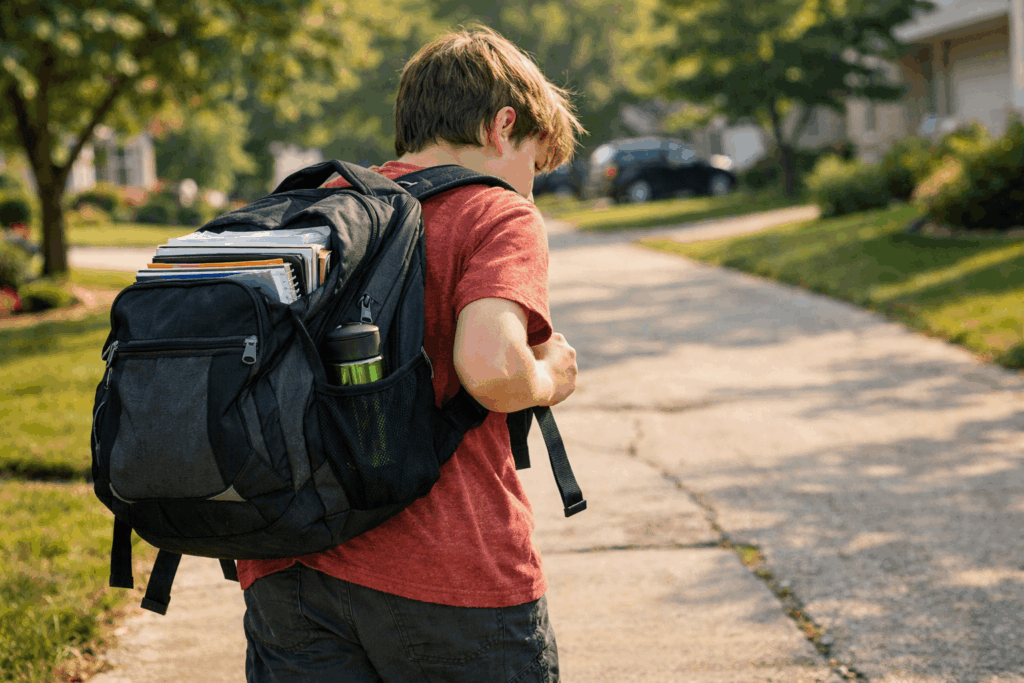
The first week of September has its own soundtrack on Long Island. New sneakers on the driveway, zippers, the bus air brakes at the corner, and the thud of a backpack hitting the kitchen floor the second your kid clears the doorway. Then a few weeks in, something quieter starts showing up. Your fourth grader keeps rubbing the same shoulder while she does homework. Your high schooler says his upper back hurts and cannot tell you why. You go to move the bag out of the hallway, actually pick it up, and think: how is he carrying this all day?
Backpack back pain is one of the most common things parents ask us about in September, and also one of the most over-dramatized topics on the parenting internet. A loaded school bag is not going to permanently bend a growing spine out of shape. What it can absolutely do is load one side of a young body harder than the other for six or seven hours a day, five days a week, and that is more than enough to produce real pain and posture habits that stick around long after the school year ends. Here is what actually matters, what the weight guidelines really say, and when a sore back is worth having someone put hands on. If your question is the broader one, whether chiropractic care for children makes sense at all, we have written about that separately.
Table of Contents
How Heavy Should a Child’s Backpack Be?
There is an actual number here, and it is lower than most families guess. The guideline most clinicians work from is that a fully loaded backpack should weigh no more than 10 to 15 percent of a child’s body weight. For a 70-pound third grader that works out to somewhere between 7 and 10 pounds. For a 120-pound eighth grader, 12 to 18. The easiest thing you can do this month is put the bag on the bathroom scale one evening, fully packed, the way your kid actually carries it.
Most parents are surprised. Two hardcover textbooks, a school-issued laptop and charger, a full water bottle, a lunch bag, and a binder will clear twenty pounds without anyone intending it. And when the load crosses that threshold, kids do not simply tough it out. They reorganize themselves around it, and it is visible once you know to watch for it. A child carrying too much weight will arch the back, bend forward, twist, or lean to one side to get the load somewhere the body can manage it. That is the compensation, not the injury. But hold a compensation long enough and it stops feeling like a choice.
Why Your Kid Comes Home Hunched Over and Aching
The thing that makes school backpack weight different from any other load a kid picks up is duration. Carrying something heavy for two minutes is a strength problem. Carrying something moderately heavy from the bus stop to first period, then between classes, then home again, is an endurance problem and the muscles doing that work are not built for it.
The muscles across the tops of the shoulders and along the back of the neck, the upper trapezius and levator scapulae, are meant to stabilize, not to hold a sustained pull for hours. When straps drag the shoulders down and back all day, those muscles switch into continuous low-grade contraction. That is the tightness you feel when you squeeze your kid’s shoulder and they flinch. It is also why the complaint almost always arrives after school rather than during it. Kids in motion are distracted; kids sitting still at the kitchen table finally notice what their body has been doing since seven that morning.
Can a Heavy Backpack Damage a Child’s Developing Spine?
This is the question underneath all the others, so let us be straight about it. A heavy backpack is not going to deform your child’s spine. There is no credible evidence that carrying a school bag, even a badly packed one, causes permanent structural damage.
What is fair to say is that a growing spine responds to load differently than an adult one. Through childhood the vertebrae are still converting from flexible cartilage into adult bone, and there are growth plates at the end of each vertebra that are susceptible to their own set of problems. Bone and soft tissue that are actively remodeling are simply more responsive to what you ask of them, in both directions, which is part of why the same repetitive strain an adult shrugs off can produce more complaints in a thirteen-year-old.
It is also worth putting one specific fear to rest, because it comes up in the office every fall. Backpacks do not cause scoliosis. Bad posture and heavy bags may be associated with back pain, but they do not cause scoliosis, and a child with a genuine spinal curve needs a real evaluation rather than a lighter bag. If one of your child’s shoulder blades sits noticeably higher than the other, or their waist looks uneven when they bend forward, that is a reason to get it looked at regardless of what they carry.
Is Wearing a Backpack on One Shoulder Really That Bad?
Mechanically, yes. This is the one habit worth actually fighting about. When the whole load hangs from one shoulder, the body has to counterbalance sideways, so the opposite hip juts out, the trunk leans away from the weight, and the loaded shoulder hikes up toward the ear to keep the strap from sliding off. The physiotherapy literature on backpack carriage describes the same thing: with a single-strap carry, the spine may side flex to compensate for the load instead of staying stacked over the pelvis.
Repeat that pattern twice a day for a semester and one side of the body gets a workload the other side never sees. The result is rarely dramatic. It is usually a teenager with a chronically tight right shoulder, a persistent ache between the shoulder blades, and no idea when it started. And here is the part parents find frustrating: kids do it because two straps look uncool, and no amount of explaining biomechanics changes that. Buying a bag they actually like tends to work better than a lecture.
Does It Matter How the Backpack Is Packed?
It matters more than most people expect, and it costs nothing to fix. Weight sitting close to the spine and high in the bag is carried largely by the trunk and legs, the way it is supposed to be. The same weight in the outer pocket, sagging low and away from the back, acts on a longer lever, which pulls the shoulders back and forces the upper body to lean farther forward to compensate.
A useful way to explain this to a kid: holding a gallon of milk against your chest is easy, and holding the same gallon at arm’s length is not. Nothing about the milk changed. So the heaviest items, textbooks and the laptop, go in the compartment closest to the back, stacked upright rather than lying flat. Light, bulky things go on the outside. And anything that does not need to make the trip should not be making the trip, which is worth a five-minute cleanout every Sunday night once you see what accumulates in there by October.
How to Fit a School Backpack Correctly
Most of the backpacks we see in the office are not the wrong bag. They are the right bag worn wrong, usually because the straps were adjusted in second grade and never touched again. A correct fit takes about a minute:
- Both straps, always. Wide and padded, tightened so the bag sits snug against the back rather than swinging behind it.
- The bottom of the bag rides at the waist, not down on the backside. If the bag hangs below the hips, the straps are too loose.
- Use the chest or sternum strap if the bag has one. It pulls the shoulder straps inward and takes a real share of the load off the shoulders.
- The bag should be no wider than your child’s torso and should not extend above the shoulders or more than about four inches below the waistline.
- Teach them to squat to lift it, using the legs, rather than bending at the waist and swinging it up onto one shoulder in one motion.
Re-check the fit at the start of every school year, and again at midyear for anyone in the middle of a growth spurt. Kids change size faster than straps get adjusted.
Are Rolling Backpacks Better for Kids’ Spines?
Sometimes, and they come with their own bill. A rolling bag genuinely takes the load off the shoulders and neck, which makes it a reasonable option for a child carrying an unusually heavy load, recovering from an injury, or dealing with a condition that makes carrying weight a problem.
The catch is that pulling a bag is itself one-sided work. One arm behind the body, trunk rotated, hour after hour, is a different asymmetry rather than no asymmetry. Add the practical realities of a school day, stairs, bus steps, crowded hallways, and a curb between the car and the door, and the bag ends up being lifted and carried anyway, usually by the handle in one hand, which is the worst version of all of this. Plenty of districts also restrict them. If a rolling bag is the right call for your kid, it usually is because of a specific reason, not as a general upgrade.
Teen Neck and Upper Back Pain After School
Teen back pain in the fall tends to have more than one input, which is why it is often the older kids who complain loudest. High schoolers carry heavier books and a laptop, often without locker access between classes, so they carry everything all day. Then a lot of them add a second bag on top of it, a sports duffel or an instrument case, slung over the opposite shoulder, and walk out to the parking lot balancing both.
A teenager describing pain across the top of the shoulders, at the base of the skull, or between the shoulder blades after school is describing a pattern we see constantly. It is usually postural and muscular rather than structural, and it usually responds well once the load and the positions change. The mistake is assuming a teenager who complains about back pain is exaggerating. Kids that age generally do not mention pain until it has been going on a while.
Is Screen Time Compounding the Problem?
Yes, and it is fair to say the backpack sometimes gets blamed for a load the phone is helping to carry. Your neck muscles support a head that weighs somewhere around ten to twelve pounds and tilting it forward even slightly can dramatically increase the load on the neck. That is where the term text neck comes from. And it is the same tissue the backpack straps were already working all day.
So a kid finishes six hours of school carrying a bag, comes home, and spends the evening in a forward-head position over a phone or a Chromebook. Neither one alone would necessarily cause a problem. Stacked, they are why September and October are consistently our busiest months for young patients with neck and upper back complaints. The fix is not a screen ban. It is holding the phone higher, propping the laptop up, and getting up to move every half hour or so.
Warning Signs Parents Should Watch For
Ordinary end-of-day soreness that clears up overnight is not an emergency. What is worth paying attention to is a pattern:
- Pain that shows up every single school day and eases on weekends and school breaks.
- A visible change in how your child stands or walks with the bag on, or one shoulder sitting consistently higher than the other.
- Numbness, tingling, or weakness in an arm or hand, or red marks and grooves left on the shoulders by the straps.
- Your child struggling to get the bag on, or leaning far forward to walk with it.
- Pain that wakes them at night, does not track with activity, comes with fever or weight loss, or has been going on for weeks and is getting worse.
That last one is a different category, and it deserves an evaluation rather than a lighter bag. Persistent back pain in a child is not something to simply monitor indefinitely, and any honest chiropractor will tell you when what they are seeing belongs with a pediatrician or a specialist instead.
Is Chiropractic Care Safe for Children and Teenagers?
This is the question we get most often, usually with a little hesitation attached, and it is a completely reasonable thing to ask. Treating a child is not treating a small adult. The force used, the positioning, and the technique are all adjusted to the size and the developmental stage of the patient, and in young children the work is often closer to gentle sustained pressure than to anything a parent would recognize from their own adjustment. A systematic review of manual therapy in the pediatric population found that adverse events were uncommonly reported, and that where studies did report them they were transient and mild to moderate in severity.
What a Chiropractor Can Actually Assess and Treat
For a backpack-related complaint, most of the value is in the exam. We look at how the shoulders and hips sit relative to each other, whether the spine moves evenly through its segments or has a restricted area, where the muscle tension has concentrated, and what happens to all of that when the loaded bag goes back on. Often the most useful part of the visit is watching your child put the backpack on and walk with it, which tells us things the child cannot articulate.
From there, treatment is usually straightforward: restoring motion to joints that have stopped moving well, releasing the muscles that have been holding tension all semester, and giving you something specific to change about the bag, the packing, and the after-school setup. Chiropractic care is a conservative, nonsurgical place to start for this kind of complaint, and if the exam turns up something that belongs elsewhere, we will say so and point you in the right direction. Dr. Goldman has been doing it that way since 1995.
Sore Shoulders Since School Started? Let Us Take a Look
At Total Chiropractic Care & Wellness in Medford, NY, we see this every fall, and we have spent decades helping our Long Island neighbors sort out what is ordinary growing-up soreness and what is worth doing something about. Dr. Todd Goldman has been practicing since 1995, and he will give you a straight read on your child’s back and shoulders, including telling you if there is nothing to treat. If your son or daughter has been coming home from school aching since the first week of September, that is worth an hour of your time rather than another month of watching it. Call us at (631) 447-2299 or schedule a visit with Total Chiropractic Care & Wellness today.