


By the time the turkey comes out of the oven on Thanksgiving afternoon, you may have been on your feet since breakfast. There was the early grocery run, the bags hauled in from the driveway two at a time, an hour of chopping at the counter, and a dozen trips bending into the oven to baste. Then the folding chairs come up from the basement, and nobody sits down until the last pot is scrubbed. The next morning, your lower back remembers every one of those jobs.
That stiff Friday morning is the hidden cost of hosting for plenty of people on Long Island. A Thanksgiving hosting injury is rarely a dramatic accident. More often, it builds from ordinary kitchen work repeated for hours: standing in one spot, leaning over a counter that is too low, lifting a heavy pan at arm’s length, and carrying more than is comfortable. Not sure whether a twinge after lifting something heavy was a strain or a sprain? Our post on the difference between a sprain and a strain sorts that out. This post stays in the kitchen: why cooking back pain and kitchen posture pain show up, how to carry the groceries and the bird, which stretches fit between tasks, when holiday prep pain deserves a professional look, and how to keep hosting strain from following you into the long weekend.
Table of Contents
Why Hours of Standing in the Kitchen Wear on Your Lower Back
Standing sounds restful next to lifting but standing still is its own kind of work. Planted at the stove or cutting board, the same muscles along your lower back and hips hold you upright the entire time, with no chance to switch off, so they tire and start to ache. That is the core of back pain from standing in the kitchen. Cleveland Clinic’s back care guidance is direct on this point: avoid standing in the same position for a long time.
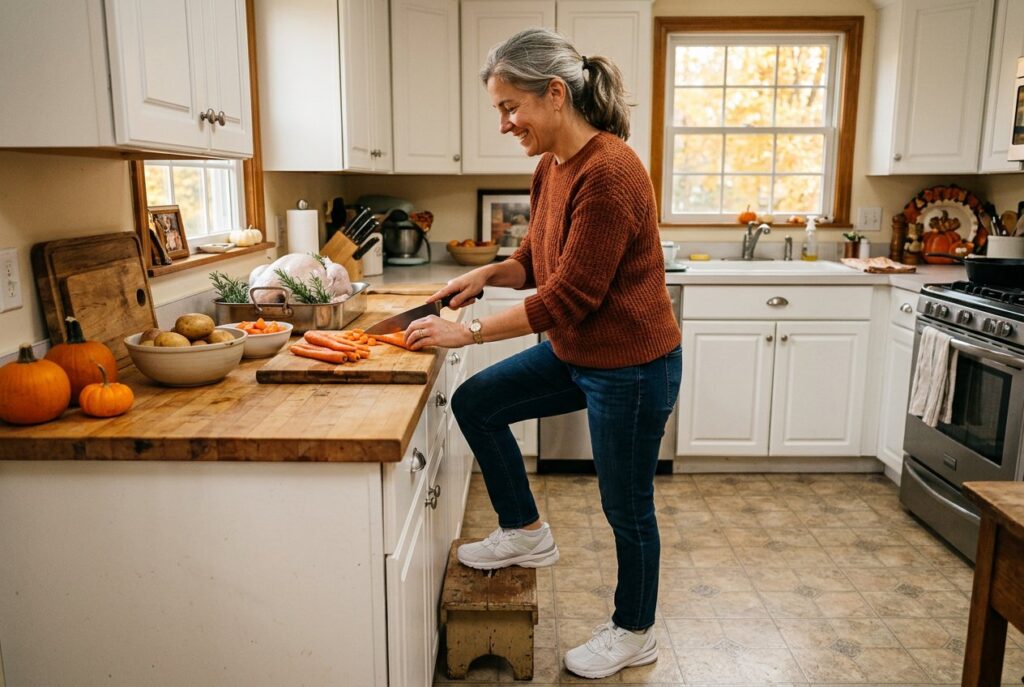
Thanksgiving makes that hard, because so much of the cooking happens in one small zone. A tip from the same guidance helps: rest one foot on a low stool or box, then switch feet every several minutes. In a kitchen, a sturdy step stool tucked under the counter works well. Shifting your weight this way changes the load on your lower back and lets one side rest while the other works.
Is Counter Posture Really Enough to Cause Pain?
It can be, especially once you add up the hours. Most kitchen counters sit at one fixed height, and most cutting boards lie flat on top of them. If you are tall, you end up hunched forward to chop and peel. If you are shorter, you may hike your shoulders to stir a pot on a back burner. Small positions like these, held for a long time, add up. Spine-health explains that prolonged hunching while standing or sitting can leave your back, core, and abdominal muscles strained and painful.
Posture is rarely the whole story, though. Kitchen posture pain usually comes from a mix of a hunched position, hours without moving, and a few heavy lifts. If the pain is sharp, runs down a leg, or keeps getting worse instead of better, something besides posture may be going on, and it deserves a proper evaluation.
A few Thanksgiving cooking posture tips for the counter: if you are tall, raise your cutting board by setting it on a sturdy, nonslip base; step in close so you are not reaching; and keep your work directly in front of you rather than off to one side, so you are not twisting all afternoon.
How to Carry Grocery Bags and a Full Turkey Without Straining Your Back
With groceries, the trouble is usually how they are carried, not only how much they weigh. Harvard Health notes that when you lift a heavy load like a grocery bag, the sudden increase in pressure on your back can irritate its joints, discs, muscles, and nerves. Holiday shopping brings the heaviest bags of the year, and a carrying groceries injury often happens on the last trip, when you try to grab everything at once.
- Split the load evenly between both hands so one side is not doing all the work.
- Make more trips with lighter bags rather than one heroic trip from the car.
- Hold heavy items close to your chest instead of out at arm’s length.
- Bend your knees to lift bags out of the trunk, and keep your back as upright as you can.
- Turn with your feet instead of twisting at the waist when you set bags on the counter.
For the turkey, slide it to the edge of the trunk first so you can get close before you lift, hold it against your body with both arms underneath, and walk it straight to the refrigerator. If your back has given you trouble before, hand that job to someone else.
Neck Pain From Hosting the Holidays: Where It Comes From
Cooking is a heads-down job. You look down at the cutting board, down into pots, down at the recipe on your phone, and down into a sink full of dishes. Spine specialists at Columbia explain that keeping the neck bent forward for long periods creates real tension, and that upper back and neck muscles work harder than usual as a result. By evening, that extra effort often shows up as tight, achy shoulders and a stiff neck.
Hosting piles on more: carrying platters, leaning across the table to refill glasses, and holding your shoulders tight while you track three timers. Neck pain from hosting holidays creeps in so slowly that it often goes unnoticed until the last guest heads home. Prop your recipe on a stand at eye level instead of flat on the counter, and every so often lift your chin and ease your shoulder blades back and down.
Does Reaching Into a Hot Oven Put Extra Strain on Your Back?
It can, mostly because of the angle. An oven door opens low, so getting to a dish means bending forward with your arms stretched out in front of you, often while holding something hot and awkward. Once is no problem for most people. Every half hour to baste and check the turkey, it adds up, combining several things backs dislike: bending at the waist, reaching away from the body, and twisting to set a dish down.
- For a quick check or a light dish, try a golfer’s lift: hold the counter with one hand, hinge forward at the hips with a straight back, and let one leg float out behind you for balance.
- For anything heavy, squat down in front of the oven instead of leaning over the open door.
- Slide the rack out toward you before you lift, so the dish is closer to your body.
- Clear a landing spot right next to the oven before you open the door.
- Use a long-handled baster and an instant-read thermometer so you do not have to bend as deeply.
Breaks While Cooking: How Often Is Often Enough?
Short, regular breaks are one of the simplest ways to keep kitchen prep back strain from building. The goal is to change position before your muscles tire of holding the old one. A short reset every 20 to 30 minutes is a reasonable rhythm for most people: walk into another room, stretch gently, or switch to a seated task for a while.
Thanksgiving hands you built-in reminders: every time a timer goes off, straighten up and take a few steps. You can also alternate tasks, peeling potatoes at the table, standing to sauté the onions, then sitting again to trim green beans. Mixing standing and sitting jobs spreads the work across different muscles.
Can a Hard Kitchen Floor Contribute to Hip or Back Pain?
It can play a part. Tile, stone, and sealed concrete floors have no give at all, and standing on them for hours can leave your feet sore and tired. When your feet hurt, you tend to shift your weight in awkward ways, lock your knees, or sink into one hip, and that strain can travel up into the hips and lower back. Cleveland Clinic suggests that an anti-fatigue floor mat can add an extra layer of separation between your feet and a hard floor.
Put one at the sink or your main prep area, and trade socks or slippers for supportive shoes with a cushioned footbed and decent arch support.
Lifting a Heavy Roasting Pan Out of the Oven, Step by Step
A loaded roasting pan comes out of the oven hot, low, and far from your body, which makes it one of the most awkward lifts of the year. The University of Rochester Medical Center’s lifting advice says to keep your arms and elbows close to the body while lifting, and that principle shapes every step below.
- Clear the counter first and set down a trivet or folded towel as a landing spot.
- Use thick, dry oven mitts that let you grip the handles firmly.
- Slide the rack out partway so the pan comes toward you.
- Get low by bending your knees and hips instead of reaching over the door from a standing position.
- Hold the pan close with your elbows tucked, then stand up using your legs.
- Step and pivot with your feet, not your waist, to set it on the counter.
It also helps to lighten the load: lift the turkey onto a platter before you move the pan of drippings, or ask someone to take one handle.
Why Hosting Stress Can Make Physical Pain Feel Worse
Hosting is physical work wrapped around emotional work: timing six dishes, greeting guests, and maybe smoothing over a family disagreement or two. That pressure shows up in the body. WebMD describes how stress and pain can feed each other, noting that stress can cause your muscles to tense up, which ratchets up the pain even more.
In real life, the same hour at the counter can feel worse on a frantic day than on a calm one. Planning ahead, handing off jobs, and stepping outside for a few quiet minutes are good for your mood, and they may help your back too.
Simple Stretches to Do Between Cooking Tasks
Plenty of stretches fit into a kitchen, and none of these require getting down on the floor. Move slowly, stay in a comfortable range, and stop any stretch that causes sharp pain.
- Standing backbend: rest your palms against the small of your back, ease backward a little, then come back to upright.
- Counter hamstring stretch: rest your hands on the counter, step back, and hinge at the hips until you feel a mild pull behind your thighs.
- Calf stretch: with your hands on the counter, step one foot back and press that heel toward the floor, then switch sides.
- Shoulder blade squeeze: pull your shoulder blades gently together and down, hold for a breath, and release.
- Chin tuck: draw your chin straight back, as if making a double chin, and hold briefly.
Hold each for a few slow breaths. If you already have a back or neck condition, ask your provider which stretches suit you.
When Back or Neck Pain After Hosting Needs a Professional Look
Some stiffness the day after hosting is common, and it usually eases over the next few days as you get back to normal, gentle movement. Certain symptoms are different. MedlinePlus advises that you contact your provider right away if back pain comes with signs such as these:
- Loss of control over urine or stool.
- Weakness or numbness in your buttocks, thigh, leg, or pelvis.
- Unexplained fever with back pain.
- Pain traveling down your legs below the knee.
- Back pain after a severe blow or fall, such as a hard slip on the kitchen floor.
- Severe pain that does not allow you to get comfortable.
Those symptoms call for your doctor first, not a chiropractic visit. If you have chest pain, trouble breathing, or sudden weakness on one side of your body, call 911.
Without warning signs, get it checked if it has not improved after about a week, flares up each time you cook or lift, or keeps waking you at night. Your first visit with Dr. Goldman begins with questions about what you were doing when the pain started, followed by an exam of how your back, hips, and neck move. Based on what he finds, chiropractic care may include gentle adjustments, hands-on muscle work, and simple exercises to do at home.
Spinal manipulation appears in many clinical guidelines as an option for low back pain: a 2024 review of clinical practice guidelines found that, of the recommendations it identified on low back pain, 90% favored spinal manipulation. That does not mean it helps everyone. Results differ from one patient to the next, and if your exam points to something better handled by your primary care doctor or a specialist, we will be upfront about it and suggest where to go next.
A Smarter Kitchen Setup for This Year’s Feast
Much of the strain of hosting can be planned away ahead of time:
- Shop in two smaller trips during the week instead of one huge one, or have the heaviest items delivered.
- Do as much prep as you can a day or two early: chop vegetables, make pie dough, and set the table.
- Put an anti-fatigue mat and a low step stool where you stand the most.
- Keep the roasting pan, platters, and big pots at waist height for the week instead of on a top shelf.
- Give guests real jobs: one to carry, one to carve, and a crew to wash dishes.
Cleanup deserves a plan too. Pull the dishwasher rack all the way out and bend your knees to load it, and let the roasting pan soak overnight instead of scrubbing it at ten at night. The meal will taste just as good, and you will feel a lot better on Friday.
Still Sore After the Leftovers Are Gone? Call Our Medford Office
A sore back or stiff neck after a long day of holiday cooking is the kind of strain we help with at Total Chiropractic Care & Wellness in Medford, NY. Practicing since 1995, Dr. Todd Goldman will check how your back, hips, and shoulders are moving, explain what he finds in plain language, and recommend a conservative plan, or a referral if that fits better. For a chiropractor for back pain in Medford, NY, holiday hosting pain relief on Long Island, or chiropractic care anywhere in Suffolk County, call (631) 447-2299 or request an appointment through our contact page.