Spring is finally here, and for a lot of people that means one thing: it’s time to get outside and get the garden going. There’s something genuinely satisfying about turning over soil, planting seeds, and watching something grow — especially after a long winter spent indoors. But if you’ve ever spent a few hours in the garden only to stand up and feel a sharp pull in your lower back or an ache that just won’t quit, you already know the downside.
Gardening injuries are more common than most people realize. Low back pain is one of the leading causes of activity limitation in adults and the repetitive bending, kneeling, twisting, and lifting that comes with yard work puts real strain on your spine and joints. That doesn’t mean you have to give up the garden, though. It means you must be smart about how you approach it.
Whether you’re a seasoned green thumb or just starting to dig in, this guide will walk you through exactly how to protect your back and knees so you can garden all season long — and actually enjoy it. And if you’re already dealing with some nagging pain, check out our chiropractic care for back pain page to learn how we help our patients get back to doing the things they love.
Table of Contents
Why Does Gardening Cause Lower Back Pain?
This is probably the first question most people ask after they hobble inside after a Sunday afternoon in the yard. The short answer is that gardening asks your body to do a lot of things it isn’t always prepared for — especially if you’re jumping into heavy yard work after months of lower activity over winter.
The main culprits are prolonged forward bending and repetitive twisting. When you bend forward to pull weeds or plant seedlings, you’re loading the muscles and discs of your lumbar spine — that’s the lower section of your back, roughly from your waist to your tailbone — in a way that can quickly lead to fatigue and strain. Add in the twisting motion of shoveling or reaching across your body, and you’ve got a recipe for soreness.
Holding the same position for too long is another factor. When you’re focused on a task, it’s easy to stay crouched or bent for far longer than you realize. Over time, the muscles supporting your spine get fatigued. When muscles fatigue, they lose their ability to protect the joints and discs underneath them.
It’s also worth knowing that the intervertebral discs — the soft, shock-absorbing cushions between each vertebra — are particularly vulnerable to compression and shear forces during bending and twisting. Repetitive flexion and rotation under load is associated with increased risk of disc injury. That doesn’t mean every bend will hurt your discs, but it does explain why doing it repeatedly for hours at a time can leave you feeling it the next day.
How to Protect Your Back While Gardening
The good news is that a few simple changes in how you garden can make an enormous difference. You don’t need to stop doing the things you love — you just need to do them a little differently.
• Bend at the Hips and Knees, Not the Waist
This is the single most important habit to build. When you need to get low, squat down using your hips and knees rather than rounding your lower back. Think of it like a partial squat or a deadlift — keep your chest up and your spine as neutral and upright as possible. It takes a little practice, especially if you’ve spent years bending from the waist, but your lower back will thank you.
• Switch Positions Frequently
One of the easiest things you can do to protect your back is to never stay in the same position for too long. Set a timer if you need to — every 20 to 30 minutes, stand up, take a short walk around the yard, and give your spine a chance to decompress. Alternating between tasks that require different postures (weeding vs. raking vs. planting) also helps distribute the load.
• Keep the Load Close to Your Body
When you’re lifting a bag of mulch, a potted plant, or even a heavy watering can, bring it in close to your body before you lift. The farther an object is from your center of gravity, the more force it puts on your lumbar spine. This is basic physics — and it adds up fast when you’re making multiple trips.
• Don’t Overdo It in a Single Session
Spring enthusiasm is real, but your body has limits — especially early in the season when you haven’t been doing this kind of activity for months. Start with shorter sessions (45 minutes to an hour) and gradually build up your tolerance over several weeks, just like you would with any physical training. The goal is a full season of gardening, not an injury on the first weekend of April.
How to Garden Without Hurting Your Knees
Back pain gets a lot of attention, but knee pain is just as common for gardeners — and for good reason. Kneeling on hard ground for extended periods puts direct pressure on the knee joint and can aggravate bursitis (inflammation of the small fluid-filled sacs that cushion the knee) as well as strain the tendons around the kneecap.
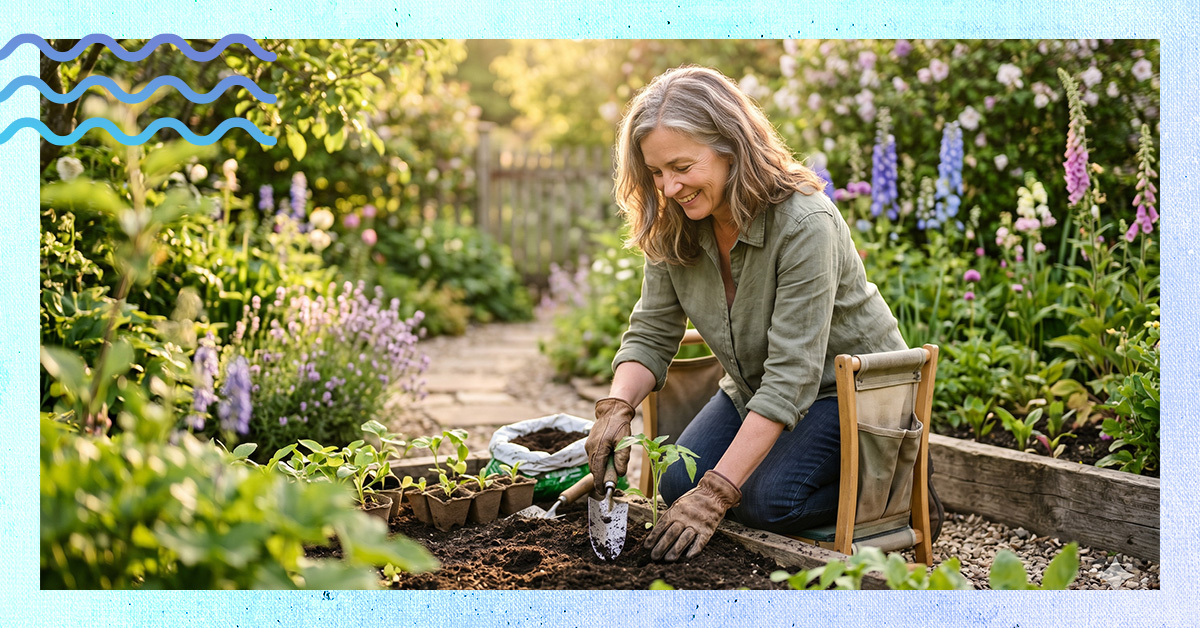
The fix is straightforward: always use a kneeling pad. A thick foam kneeler or a padded garden cushion makes a huge difference in reducing direct compression on the knee. Many gardeners swear by a garden kneeler bench — a padded seat with handles on either side that doubles as a low bench and lets you push yourself up without putting extra strain on your knees or wrists.
If kneeling still bothers you, try using a low garden stool or rolling seat instead. These let you get close to the ground without putting any weight on your knees at all. Long-handled tools are another good option — they let you reach further without having to get down as low.
If you’re already dealing with chronic knee pain, strengthening the quadriceps and hip muscles has been shown to reduce knee pain and improve function. Ask your chiropractor about targeted exercises you can do year-round to keep your knees strong and resilient.
Warm Up Before You Dig In
Most people wouldn’t jump into a run or a gym session without at least a little warm-up. Gardening deserves the same respect — it’s physical labor, even if it doesn’t always feel like it.
Before you head outside, spend five to ten minutes doing some gentle movement to get your body ready. A short walk, some light leg swings, hip circles, and gentle torso rotations can go a long way toward reducing muscle stiffness and priming your joints for the work ahead. The goal isn’t an intense workout — it is simply getting blood moving into the muscles that are about to do the heavy lifting.
After you’re done gardening, stretching is just as important. Spend a few minutes stretching your hamstrings, hip flexors, and lower back. These are the muscle groups that take the most stress during gardening, and a bit of post-activity stretching can significantly reduce next-day soreness.
The Right Tools Make a Big Difference
Your tools are an extension of your body, and using the wrong ones for the job can force you into awkward positions that put unnecessary strain on your spine and joints.
Here are a few tool upgrades worth considering:
- Long-handled tools: Rakes, hoes, and cultivators with longer handles let you work upright or with only a slight forward lean, rather than hunched over.
- Ergonomic grips: Tools with cushioned, angled, or pistol-grip handles reduce the strain on your wrists, forearms, and shoulders.
- Lightweight materials: Fiberglass and aluminum tools weigh significantly less than traditional wooden ones — and that adds up over a long afternoon.
- Wheeled carts: Instead of carrying heavy loads of soil, mulch, or debris, use a garden cart or wheelbarrow to let the wheels do the work.
Raised Beds and Ergonomic Gardening
If you’re serious about gardening long-term and want to protect your spine for years to come, raised garden beds may be the single best investment you can make. By elevating the soil to a comfortable working height — typically around 24 to 36 inches — you eliminate the need to bend, squat, or kneel almost entirely.
Even a modest 12-inch raised bed dramatically reduces the range of forward bending required compared to working at ground level. For gardeners with existing back problems or those who have had spine surgery, raised beds can be genuinely life-changing — allowing them to continue a hobby they love without the physical cost.
Container gardening on tables or stands works on the same principle. It’s worth exploring how much of your gardening can be adapted to a standing-height setup, especially for frequently tended plants like herbs and vegetables.
Listen to Your Body
There’s a difference between the normal, satisfying tiredness that follows good physical activity and the kind of pain that’s telling you something is wrong. Learning to tell them apart is an important skill for any gardener.
General muscle fatigue and mild soreness that shows up the day after activity? Completely normal. Sharp pain during a movement, pain that radiates down your leg, or pain that doesn’t improve after a day or two of rest? Those are signals worth paying attention to.
In particular, pain that radiates from your lower back down through your buttock or leg — sometimes called sciatica — may indicate nerve involvement and should be evaluated by a healthcare provider. Similarly, any new knee swelling, instability, or persistent joint pain that doesn’t resolve in a few days is worth getting checked out.
Should I See a Chiropractor for Gardening-Related Back Pain?
It’s a fair question, and the honest answer: it depends on what you’re experiencing. But chiropractic care is often one of the most effective options available for the kind of muscle and joint pain that comes from gardening.
Chiropractors specialize in the diagnosis and treatment of musculoskeletal conditions — that is, problems involving your muscles, joints, and the nerves that serve them. For lower back pain specifically, spinal manipulation has been shown in multiple clinical trials to reduce pain and improve function compared to other conservative treatments. It’s also non-invasive… which means no medications, no injections, and no downtime.
Beyond adjustments, a good chiropractor will also evaluate your posture, movement patterns, and any muscle imbalances that might make you more vulnerable to injury. They can give you specific stretches and exercises tailored to your body — not generic advice, but a plan built around how you actually move.
If gardening-related pain has slowed you down or you want to get ahead of it before the season really ramps up, a chiropractic evaluation is a smart first step.
Ready to Dig In — Pain-Free?
At Total Chiropractic Care & Wellness in Medford, NY, we work with active people every day who want to stay mobile, comfortable, and doing the things they love — whether that’s gardening, running, playing with grandkids, or anything in between. If back pain or knee pain is getting in the way of your spring garden plans (or if you just want to make sure that you’re set up to avoid it), we’d love to help.
Our team offers personalized chiropractic evaluations and treatment plans designed around your body and your life. Contact us today to schedule your appointment — and let’s make sure this gardening season is your best one yet.
If this was useful, tell Google you want more of it.
Leave a Reply